This content contains scenes that may shock an uninformed audience.
Do you still want to watch it?
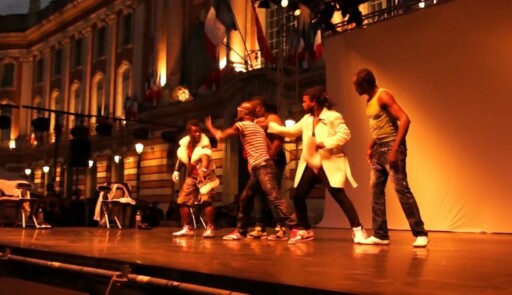
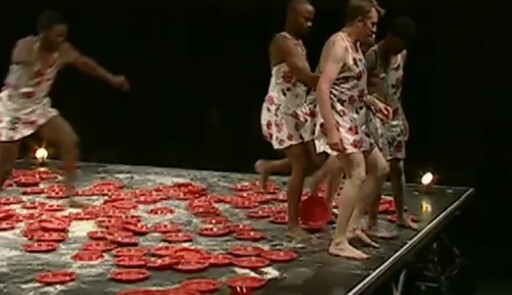
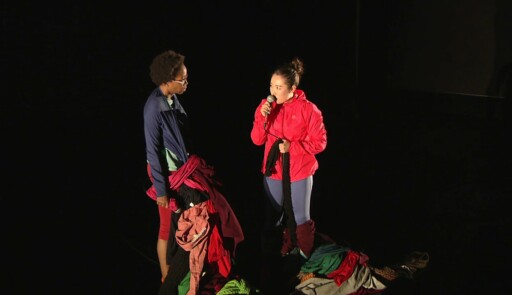
Coupé Décalé - Act 1, Excerpt 2
The Coupé Décalé project focuses on contemporary choreographers’ perspectives on this popular practice originating from the Attiée culture (Ivory Coast) that emerged in Paris in the early 2000s.
COUPÉ-DÉCALÉ / ROBYN ORLIN & JAMES CARLES
PROJECT IN TWO ACTS – Created in February 2014
ABOUT THE PROJECT
Popular dance appears as an individualized behavior that allows performers to select, reproduce, or combine elements of the pre-existing movement code (…) As a means of artistic communication, the choreographic signs of folk dance do not have their own individuality in the communication process. They are grouped into structures and forms (with clearly defined internal functions) according to certain models established by tradition and determined by the logic of choreographic thought, thus constituting the expressive elements capable of conveying a message. It goes without saying that popular choreographic language and dance itself are in a dialectical relationship of interdependence and mutual conditioning. In this sense, it is impossible to conceive of the performance of a dance outside the prior process of learning; on the other hand, the choreographic language lives and is enriched only through its practice.
(Some theoretical aspects of the analysis of popular dance by Vera Proca-Ciortea and Anca Giurchescu). The Coupé-décalé project focuses on the way contemporary choreographers view this popular practice, which originated in the Attiée culture (Ivory Coast) and appeared in Paris in the early 2000s. Today, contemporary creation draws on a number of popular practices and interprets them to fuel a “new choreographic language,” an eternal return as a source of inspiration.
FROM TRADITIONAL DANCE TO A POPULAR AESTHETIC AND SOCIOLOGICAL PHENOMENON
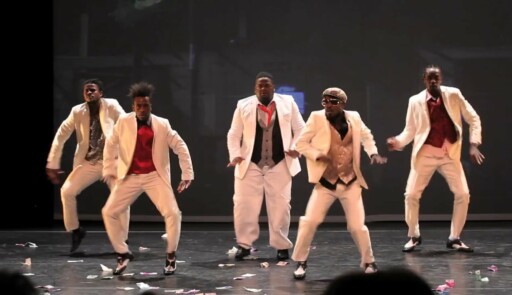
The name “coupé-décalé” comes from a traditional dance form in Ivory Coast: the Akoupé of the Attié ethnic group in Ivory Coast. In the early 2000s in Paris, this movement, which combines dance and urban music (mixing Congolese rumba, hip hop, Caribbean music, and popular French songs), was driven by the black community of African and Caribbean origin. For these disoriented and penniless young people (students and undocumented immigrants), it was a way of giving themselves an illusion of success and respectability by frequenting the biggest “Black” clubs in Paris alongside a truly wealthy population who displayed the outward signs of their new social “success” with a certain insolence. These parties gave rise to “showing off” competitions (farôter): the person who was best dressed, i.e., who wore the biggest brands and spent the most money, was declared the winner.
Gradually, individuals formed groups and organized a new kind of “battle.” This led to the emergence of groups such as the “Jet Set” in Paris, the “Jet8,” and the ‘Intouchables’ in France, as well as groups abroad such as the “Siciliens de Genève” in Switzerland and the “Cour Royale” in London. These groups engaged in fierce “battles” and developed a new language, clothing style, and rituals, such as distributing large sums of money to the audience, known as “le travaillement.” It was music producer David Monsoh who, observing these very particular “games” played by young adults (aged between 18 and 24), had the idea of turning them into a major popular movement. The “Jet Set” of Paris was chosen, and the leadership was naturally given to Doug Saga, who was naturally eccentric, extravagant, and impertinent.
Over time, the dance became popular thanks to a group of Ivorian DJs such as DJ Jacob, and was named “Décalé-coupé” and then ‘Coupédécalé’ for aesthetic reasons. Douk Saga released the first track, called “Sagacité,” in 2003. The music video “Saga-cité” promoted not only the dance, but also the concepts associated with coupé-décalé: “Farot farot” (showing off), “Boucantier” (a man who makes a name for himself, who makes a ‘Boucan’ or noise), and “Travailler” (throwing banknotes around). It was then that the boucantiers of the JetSet arrived in Abidjan, and performances and concerts multiplied, notably a giant concert at the Palais de la Culture in Treichville.
The names of the dances and music are quite evocative: economic crisis (music and dance title: Qualité de vie (Quality of Life)/Lâcheté (Cowardice)), war in Iraq (music and dance title: Guantanamo), epidemic (music and dance title: grippe Aviaire (Bird Flu)), etc. There are also more ‘lighthearted’ or more ‘political’ texts (music and dance title: On ne sait pas où on va mais on y va quand même ! (We don’t know where we’re going, but we’re going anyway!)). One of the avatars of this aesthetic is “LOGOBI,” music and dance in its most basic, popular, and consensual form (title: Corde à sauter (Jump Rope)…).
This aesthetic quickly spread throughout French and African society in all its forms. Although predominantly embraced by young people from disadvantaged backgrounds, their ambitions transcended social, ethnic, racial, and national divides. It was spontaneously adopted by young people across all continents. The dance is practiced by both men and women, but the “male presence” is more prominent. Parisian DJs contributed greatly to the development and spread of this dance/music. The dances are improvised and each “basic step” or “concept” is named. There is reciprocity and coincidence between the dance and the concept behind it. This music/dance has many faces: social and political satire, dance with strong sexual connotations, pure entertainment, etc.
FROM POPULAR PHENOMENON TO CHOREOGRAPHIC PROJECT IN TWO ACTS
The project, deliberately split into two parts, features dancer and choreographer James Carlès in a vision appropriated by Robyn Orlyn. The South African choreographer is known for her passion for all dance and identity phenomena linked to black culture. As for James Carlès, he continues his research into the origins and emergence of Black dance forms and their spread throughout the world.
In the second act, he offers his vision of coupé-décalé with dancers chosen for their knowledge and mastery of this dance form. The two acts thus offer a confrontation of perspectives that tends to reflect our own approach to Black dance.
COUPÉ-DÉCALÉ / ACTE 1 / I AM NOT A SUB-CULTURE, RATHER A GALLERY OF SELF-PORTRAITS WITH A HISTORY WALKING IN CIRCLES
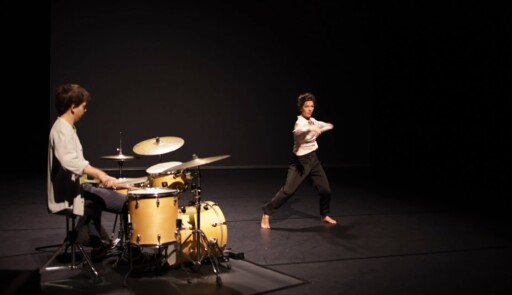
SOLO BY ROBYN ORLIN FOR JAMES CARLES
“I know more about English-speaking Africa than French-speaking Africa, and I had never heard of coupé-décalé. James Carlès came to see me and showed me footage filmed in nightclubs, which reminded me of the dances and movements that emerged from the townships of South Africa at the end of apartheid. Kwaito in the 1990s and pantsula a little earlier offered a means of expression to the younger generations, who found in them an outlet for their misery and a way to assert themselves. In all these popular dances and movements, I find a combination of humor, painful history, and humanity.
We watched videos of his choreographed pieces and, above all, we talked a lot, discussing topics that affect us both personally: how we are viewed in our own country and in countries where we are foreigners, how our children are viewed in those countries…
We had significantly different experiences and perceptions, but our questions were the same. So I suggested the idea of creating a solo with him. I am curious to see how he can bring his personal history, between Cameroon, the United States, and France, to the stage. And I would like to place this history in a broader context, that of Europe, where I see a line of color running through societies.
When I decide to work on forms of popular expression, I like to go to the source and build the show with people who really practice this form of dance or music at home. This is what the members of the Via Katlehong Dance group allowed me to do, mixing South African pantsula and gumboot for the show Imbizo e Mazweni.
I work very intuitively, in the moment with the dancer or dancers, based on their storytelling, their history, and the way they tell that story. For this solo, we would probably use dancefloor music and James’ interest in coupé-décalé, especially since creative clothing and elegance are important characteristics of the movement. I’m also very interested in this dimension.” – Robyn Orlin
Interview by Dominique Crébassol (November 2012)
COUPÉ-DÉCALÉ / ACT 2 / ON VA GÂTER LE COIN !
PIECE BY JAMES CARLÈS FOR 5 DANCERS
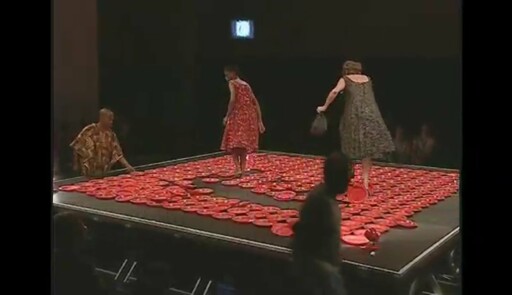
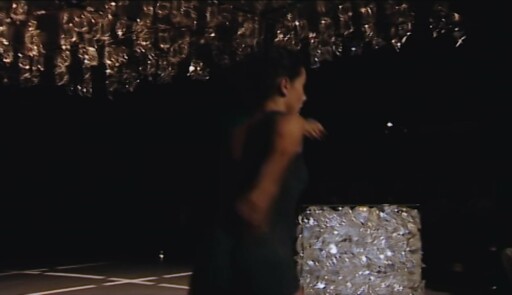
VIDEO WORK WHAT ONE KNOWS OF THE ORIGIN OF THE WORLD/CHARLES ROSTAN
My work on the video “Coupé-décalé. Act 2: On va gâter le coin !” was inspired by Stephen Smith’s essay (Négrologie: Pourquoi l’Afrique meurt, published by Calmann-Lévy, 2003), whose starting point “makes perfect sense to anyone who is unbiased, who neither loves nor hates Africa, and who is not ashamed of themselves: The present has no future on the continent. The freedom of tone is that of urgency, without contempt for anyone.”
Coupé-décalé seems to me to have been born out of this urgency, a hybrid dance, an expressive form based on opposites, an emancipation in the face of the harshness of everyday life. “Akoupé” symbolizes the cut body and means to cheat, steal, swindle. “Décalé” symbolizes the idea of making a fortune by leaving or running away. It is in this analogy that the image of this matrix-like, conflictual body appeared to me, generating images of present-day Africa, a present absence. Africa is the deathbed of all hopes, but why is it dying? Because it is committing suicide in an environment dismantled by globalization. I myself exploit this body as one exploits the resources and riches of this country. It is the image of the trunk of the world, the body of the original black woman, founder, creator, but a body in pain, lying down, dying, and deprived of its limbs to act. Like Stephen Smith in the conclusion of his book, I am addressing here my “Western friends who perceive the black continent as a large natural park and its inhabitants – unchanged since the dawn of time, as if haunted by old demons. […] They [thus] maintain a crazy dream that kills.”
The temporality of the video reflects this assisted suicide, this gap between late modernity and authentic cultures. The images shown perpetuate this crazy and murderous dream. There are survivors in this ocean of misery. Certainly, Africa is eternal; it is the cradle of humanity before it became its tomb. Yes, fortunately, Africa is moving, bodies are moving and living with apparent simplicity, but now I imagine moving corpses.
Are they stirring in a macabre dance?