This content contains scenes that may shock an uninformed audience.
Do you still want to watch it?
Concrete
with the Ictus ensemble, based on Michael Gordon's musical work
“Since Professor, Maud Le Pladec has been conducting research into the connections between dance and the expressive potential of contemporary music. From Fausto Romitelli’s rough distortions to Julia Wolfe’s refined rhythmic constructions, she explores new sound territories that push her to rethink her choreographic vocabulary, inventing forms that dialogue, exchange, resonate, or clash with the singularity of these riffs, frequencies, and loops. Continuing the exploration of American post-minimalist music begun with Democracy, Concrete plunges us into dense and colorful material. Written in the mid-1990s, Michael Gordon’s Trance reveals the influence of minimalism filtered through the hubbub of the 1980s and 1990s: this score, repetitive in structure and baroque in texture, allows him to experiment with aesthetic hybridizations, where the orchestra collides with pop, glam rock with meditation.
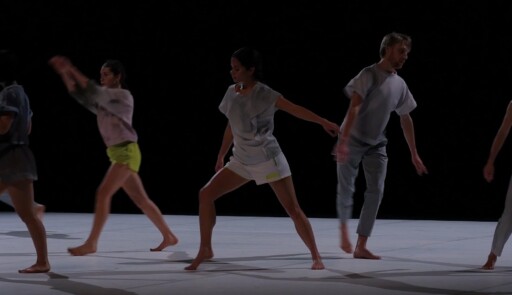
To choreograph these trances and plunge the audience into a hypnotic drift, she positioned herself at the edge of genres and registers—drawing from the sound material a group of spectral creatures straight out of Ziggy Stardust’s brain. Oscillating between several states, the dancers take turns becoming elements of the orchestra, voices that adjust to the composition, subliminal figures, or moving elements—shifting attention, marking zones of meditation and vertigo, moving from the frenetic dance floor to the immobility of statues. Like intermediaries circulating the intensity of the instruments to the bodies and the bodies to the space, they constantly interact with or disrupt the musical flow, blending into it or expanding its perimeter. Plugged into alternating current, their silhouettes highlighted by the light drift along these trances like so many signs bearing intertwined layers of reference. Between inner journey and transformation of space, Concrete deploys different levels of listening and porosity to music. Invisible or overexposed, the dance hollows out the holidays, cuts up the stage, erases, rewrites, highlights, amplifies—activating a phantom, subliminal perception, where everything seems to float between infinite speed and vibratory immobility.”
Gilles Amalvi

![Miniature de la vidéo Fan Dance [Danse des éventails] [transmission 2014]](https://numeridanse.com/app/uploads/2017/05/Fan-Dance-Danse-des-eventails-transmission-2014-41014-512x295-c-default.jpg)