This content contains scenes that may shock an uninformed audience.
Do you still want to watch it?
Autumn Fields
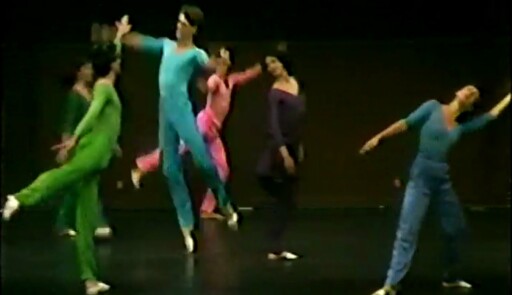
Autumn Fields is a choreography characteristic of Cunningham’s legacy, consisting of several sequences, connected by no logical link and evolving according to its own structure.
Philip Glass is a former student of Nadia Boulanger and the Julliard School of Music. He is a leading figure in so-called “repetitive” music, based on imperceptible progressions and subtle structural ‘sideslips’, greatly influenced by non-European musics.
The choreographer, Viola Farber, a remarkable figure in American Modern Dance, was one of the main performers in Merce Cunningham’s creations for 12 years, before founding her own company. She created Autumn Fields for and by the Ballet Théâtre Contemporain.
The piece finds its unity in the music and scenography of François Morellet, a visual artist who, after participating in the research of GRAV (Groupe de Recherche d’Art Visuel) and worked with kinetic artists, set out to pursue a body of work that combines, with unexpected humor, constructed abstract art and minimal art. Morellet invented a system of grids suspended from the ceiling that gradually invade the stage above the dancers. Their size and shape vary through a series of openings and closings so that their shadows cast on the stage accompany the dancers’ constant movement.
Each element of Autumn Fields evolves according to its own structure and the obsessional shifts in Philip Glass’s music, finding an echo in the imperceptible variations of Morellet’s grids and in Viola Farber’s choreography.
Source: CCN Ballet de Lorraine

![Miniature de la vidéo Mes amis [adaptation]](https://numeridanse.com/app/uploads/2014/04/Mes-amis-adaptation-23596-512x295-c-default.jpg)