This content contains scenes that may shock an uninformed audience.
Do you still want to watch it?
Prologue #1 pour Psaumes
ABOUT THE PSAUMES PROJECT
With “Psaumes,” I would like to explore and “capture” the multiple meanings of relationships as they play out in society today.
What is sacred? What is sacred today?
Why is it sacred? How does the meaning of the sacred change based on personal or collective trajectories? What is my approach to the sacred? What is sacred to me? What do I desacralize? What are my sacrileges?
These are all questions that drive me.
At this stage in my personal and professional journey, I feel the desire to write contemporary psalms. It will not be sung poetry, but a poetic dance flow, about relationships (what connects us).
James Carlès – Artistic Director
ABOUT THE PIECE
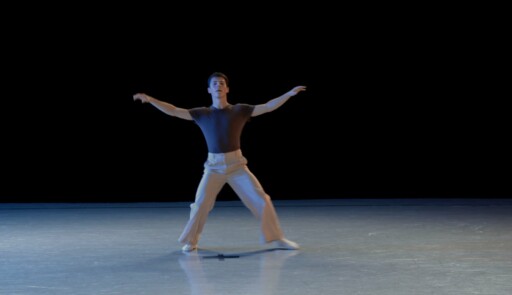
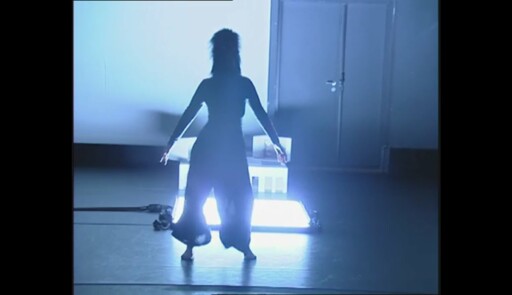
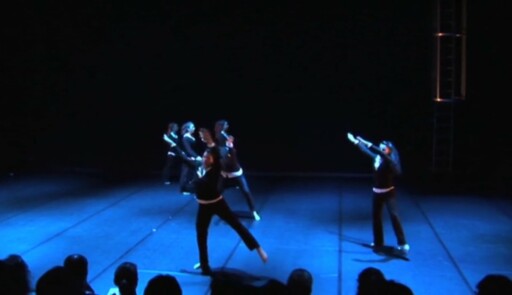
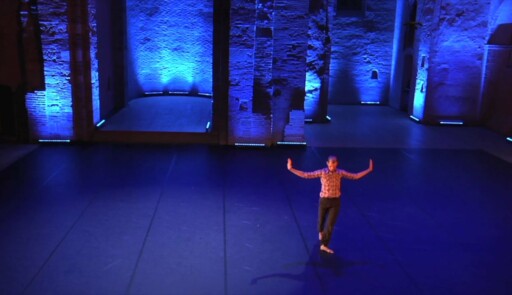
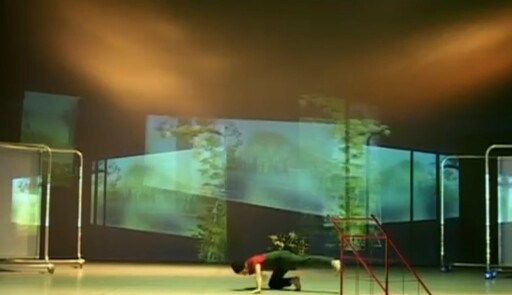
Prologue pour Psaumes is the choreographer’s exploration of the sacred. The Montauban Baroque Orchestra, conducted by Jean-Marc Andrieu, offers an original and powerful interpretation of the music of Chevalier de Saint-George. Against this musical backdrop, the three performers bring energy and uniqueness to the specially designed stage. The creation of video artist/visual artist Elise Perrier adds further layers of meaning that are playful, offbeat, and rich in symbolism. This piece echoes and pays tribute to Franco-Burkinabe visual artist Kely Kabré, whose work was based on creating art from recycled waste, as well as to the late Dr. Jean Emmanuel Kamtchueng (a Franco-Cameroonian pharmacist and former president of the Maison de l’Afrique in Toulouse), who introduced me to the works and character of Chevalier de Saint-George. The music of Chevalier de Saint-George, firmly rooted in its time, exudes a rhythmic energy fundamentally linked to dance. In the “Musique vivante” version, the Les Passions orchestra is composed of four musicians for the performance of Chevalier de Saint-George’s quartets (two violins, one viola, one cello).
James Carlès
The Chevalier de Saint-George Joseph Bologne: Although he captured the imagination of many novelists, the Chevalier de Saint-George, already legendary in his own time, long eluded the attention of historians. Joseph Bologne de Saint-George was born into slavery in Guadeloupe on December 25, 1745. His father was a wealthy plantation owner of Dutch origin and his mother a Creole slave born in Guadeloupe. A boarder at one of the best academies, trained as the son of a great lord by the fencing master La Boëssière, Joseph Bologne became known in Parisian society as the Chevalier de Saint-George. Alongside his social success, Saint-George became an accomplished virtuoso. At a very young age, he was put in charge of the Concert des Amateurs, one of the best musical ensembles in the world, and began to compose. It was through his quartets, symphonies, violin concertos, and operas that he charmed and dazzled audiences, inspiring the young Mozart and Choderlos de Laclos, his first librettist. He frequented the abolitionist circles of the 18th century and, through his social position, was a figurehead for the emancipation of slaves in the European colonial empires. Saint-George’s music, known only to a few specialists, remained buried for two centuries under the dust of the archives until the general public was able to discover it in all its splendor and, with prejudices overcome, it finally entered the repertoire, where it deserved to be.
Kely Kabré: Visual artist. Justin Kabré, known as Kely, was born in 1974 near Ouagadougou. He learned wood carving from his father, a traditional sculptor. He spent a year learning metalworking techniques at the Oloron Foundation and studied painting at the Boromo Center, where he perfected his knowledge of traditional arts. In Ouagadougou, where he lives and works, he creates numerous decorations and pieces of furniture and regularly exhibits his work in various locations around the city. In 2006, he made his first three-month trip to France, creating around thirty sculptures which he exhibited in Toulouse at the “Salon du 22,” then at the “Apollo” cultural center in the city of Mazamet and at Atelier 16 in Revel. This was followed in 2007 by several exhibitions and invitations to various festivals. In the summer of 2007, the “Galerie 5” in Toulouse presented a broad overview of his work. Neither international art, nor craftsmanship, nor airport art, Kely’s art has been described by artist Michel Batlle as “accidental art,” that is, art that stands out and breaks with uniform Western thinking through its ethnic inspiration, bringing a new form of renewal to a situation where art has lost its humanistic function and become nothing more than a market.
The Maison de l’Afrique in Toulouse (M.A.T.): The M.A.T. was founded on February 29, 1992. Its goal is to enable the people of Toulouse and the Midi-Pyrénées region who wish to do so to learn more about Africa and its socio-cultural diversity. It promotes cultural dialogue by providing better information about Africa and its relations with Europe in particular, through appropriate initiatives to promote exchange, mutual aid, and solidarity. Since its creation, the M.A.T. has taken a stance on issues that are still relevant today. Since 2000, it has given its work, in various forms, a particular focus, always in line with its original objective: to provide better information on “Africans in Europe.” The fight against racism and discrimination begins with a fight against ignorance and misunderstanding of others. The M.A.T. has therefore chosen to focus its efforts on remembrance work, which consists of raising awareness of the role played by Africans and their descendants in European history and their contributions to that history. Changing perceptions of others is the first step toward changing behaviors. This is a civic endeavor aimed at the general public (people of all ages and backgrounds). In each area of this initiative, the results may be published, which is why the publishing house MAT-EDITIONS was created.