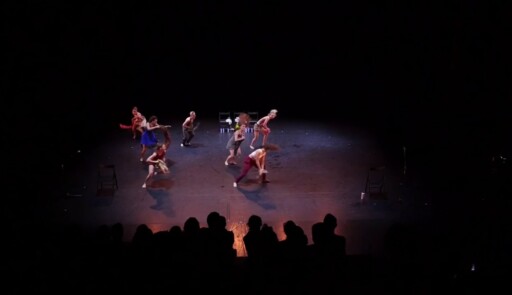
This content contains scenes that may shock an uninformed audience.
Do you still want to watch it?
Les pas perdus
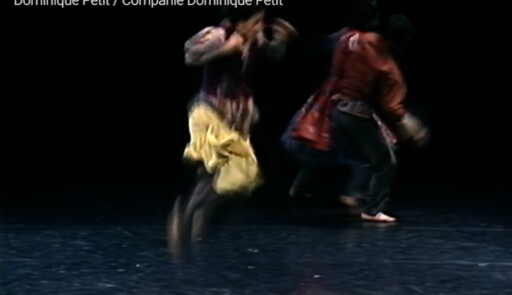
Aranzaquil and Les pas perdus
The creation of these two pieces at La Maison de la Danse in December 1983 was an opportunity for me to create my first real group piece after an unfortunate experience two years earlier at the Festival d’Avignon. I was fairly inexperienced in communicating about my work and, moreover, I don’t remember having the opportunity to write a few lines about my intentions for the program distributed to the audience. I would like to take advantage of this archiving initiative to revisit what underpinned the writing of these two ballets, which were conceived as a true diptych. At the time, I regularly went to see Peter Brook’s productions at the Théâtre des Bouffes du Nord and was deeply impressed by his 1979 film “Meeting with Remarkable Men,” based on the work of Georges Gurdjieff. The film traces Gurdjieff’s spiritual quest in search of a mysterious brotherhood, which he eventually finds in the Gobi Desert after a long journey. There he discovers a small community for whom the pursuit of elevation involves the assiduous practice of music and dance. There is a dance scene that particularly impressed me with its clarity and power. But above all, this film revealed to me the existence of a tradition I had never heard of before, whose initiatory and communal dimensions reinforced my desire at the time to connect spiritual exploration with artistic practice. These two pieces, created in Lyon in 1983, were my way of responding to the impact of this film. Les pas perdus was therefore conceived from the elements that had struck me in this dance scene from the film: a rigorous construction and geometry based on a very present rhythm. I asked Denis Levaillant to write a score based on nine beats, offering multiple internal combinations, and he suggested that it be performed on the Zarb, a traditional Iranian percussion instrument, by Youval Missenmacher. I wrote a dozen choreographic phrases based on this nine-beat rhythm, which underpins almost the entire dance, playing on a multiplicity of orientations for each of the phrases and on combinations of duets, trios, quartets, etc. But from the outset, I knew that this dance would only be part of the program and that there had to be a sequel that would reflect the threat I perceived to the transmission of certain traditions. So I imagined a second part in the form of the debacle of a small group of people violently driven from their territory and forced into an exodus that cuts them off from their cultural roots. I invented the name of a village, “Aranzaquil,” located, for me, in Afghanistan before the invasion by the Soviet Union. Unlike the first part, which was written entirely as a score, this part of the diptych was composed from a multitude of scenes resulting from improvisations proposed to the dancers based on different themes related to exodus, deportation, and the loss of cultural and spiritual landmarks, the sequence of which shows the progression of the characters’ inner uprooting. In this second part, the composition of the music followed that of the dance, with Denis Levaillant coming to the studio to see the progress of the writing of the successive sequences and then composing the music as it went along. The costumes, like the sets, were designed and created by Francis Coulet. The costumes were inspired by traditional village clothing (based on Japanese kimonos), ritualistic in the first part and more everyday in the second. The lighting design was by John Davis, whom I knew well as Carolyn Carlson’s lighting designer at GRTOP. This was my second collaboration with Denis Levaillant after our duo “D. D. Blue Gold Digger” presented at the Centre Georges Pompidou in 1982.
Dominique PETIT
December 2021

![Miniature de la vidéo Solides [transmission 2017]](https://numeridanse.com/app/uploads/2017/06/Solides-transmission-2017-41338-512x295-c-default.jpg)
![Miniature de la vidéo Gueule de loup [transmission 2015]](https://numeridanse.com/app/uploads/2016/05/Gueule-de-loup-transmission-2015-37333-512x295-c-default.jpg)